A Discussion Guide for Community-Engaged Participatory Projects
Introduction
Community-engaged research is essential for building capacity among populations who have historically been and continue to be excluded from conversations about their own well-being and the places in which they live and work. Engaging communities in research works toward racial and class equity and environmental justice. This model also has the added benefit of making research more relevant and effective by engaging community-held knowledge, without being exploitative of the people holding that knowledge.
Goals of this Guide
This guide serves to provide guidance for researchers who are in the project planning phase, and to encourage research teams to include community partners in projects, particularly in leadership roles, and to educate researchers on how to do it.
When developing a new project, teams should be able to use this guide as a resource, read through it, and discuss whether and to what extent community partners will be involved.
Each of the points outlined in the guide should be discussed, considered, and reconsidered throughout each project, rather than simply checked off.
Instructions for Using this Guide
When developing a new project, read through this guide and discuss whether and to what extent community partners will be involved. Each of the points below should be discussed, considered, and reconsidered throughout each project, rather than simply checked off.
Information Covered in this Guide
The Discussion Guide for Community-Engaged Participatory Projects provides guidance and prompts regarding the following:
- Types of community-engaged research
- Community compensation, including compensation amounts, communication, and payment processes
- Considerations for if your project could benefit from community-engagement
- Power-distribution when engaging with community members
- Recruitment and outreach to community members
- Research methods and research participant recruitment
- Communication throughout community engagement, including team meetings
- Budget development
- Data collection, analysis, and ownership
- Finding interpretation and dissemination
Access the Guide
The Discussion Guide for Community-Engaged Participatory Projects is available in multiple formats. Feel free to print a hard copy, download it to keep on your computer, or share it with others!

PDF format
This version of the Discussion Guide for Community-Engaged Participatory Projects focuses solely on the content of the guide without additional space allotted for team notes.
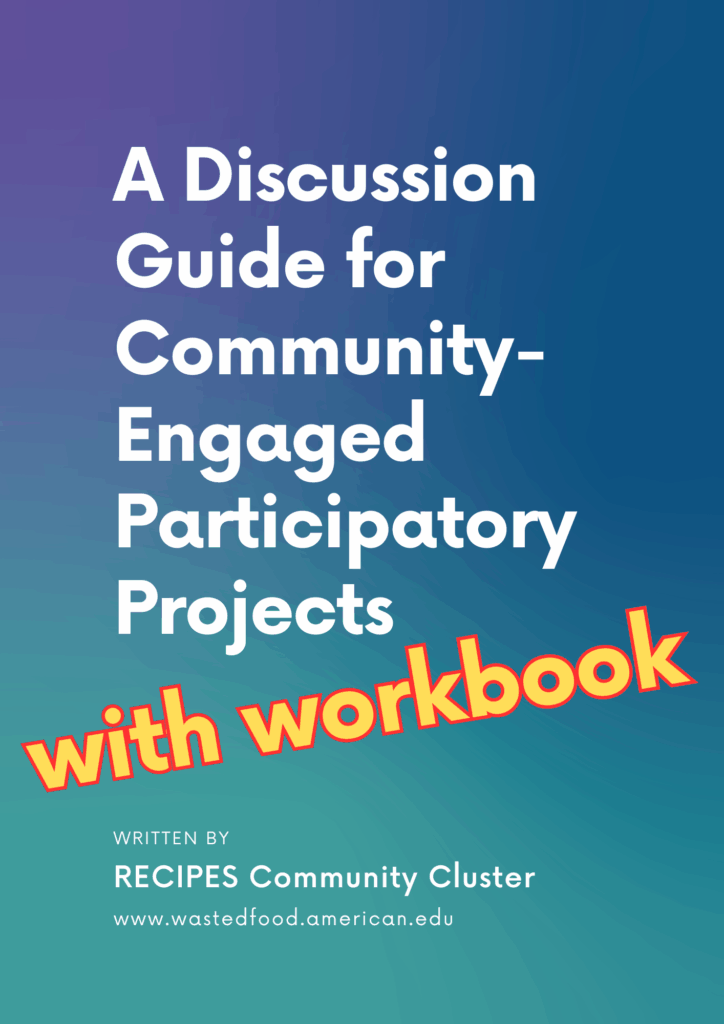
PDF format *with Workbook*
This version of the guide is the same as the PDF format, but includes text fields for teams to write down any notes, questions, etc. It is best for printing and handwritten notes, but can also be edited on a computer using a PDF reader/editor.

Google or Word Document format
Like the PDF with Workbook, this version of the document includes text fields for project teams to fill out. However, this iteration may be easier for teams to edit and allows for multiple team members to edit the document at the same time. This version can be downloaded and uploaded to your Google Drive account for easy cloud-based collaboration with others.

Mural Template
We have also created an interactive Mural template of the Discussion Guide for Community-Engaged Participatory Projects as another way for multiple team members to work on each prompt simultaneously. Mural is an online collaboration tool, similar to a digital whiteboard. We recommend opening this Mural template in a new window and saving a copy to your Mural account. You can then send an invitation link to your collaborators.
Citation:
If you would like to cite the RECIPES Discussion Guide for Community-Engaged Participatory Projects as a reference, please use the following information:
Harper, K.; Labruto, N.; Espat, Stack Whitney, K.; Edwards, C.; Ashton, W.; Neff, R.; Wilson, N.; Apolzan, J.; Santa González, R.; RECIPES Network (2025) A Discussion Guide for Community-Engaged Participatory Projects
RECIPES doi 10.57912/30581912
https://aura.american.edu/account/articles/30581912
Funder Statement:
This work was supported by National Science Foundation (NSF) Grant # 2115405 SRS RN: Multiscale RECIPES (Resilient, Equitable, and Circular Innovations with Partnership and Education Synergies) for Sustainable Food Systems. Opinions expressed herein are those of the authors and do not necessarily reflect the views of NSF.
Creative Commons License:
This work is licensed under the Creative Commons BY-NC-SA License. To view a copy of the license, please visit creativecommons.org/licenses/by-nc-sa/4.0/